Goal
The party interface file served by the official page on 28 October 2026 contains the How to Play dialog. It says to answer before the puffer explodes, use rarer answers to build toward an extra heart, and avoid answers already used for the current question. Its introduction identifies the last remaining player as the winner. This check read public files without joining a room or playing a match.
Turn flow
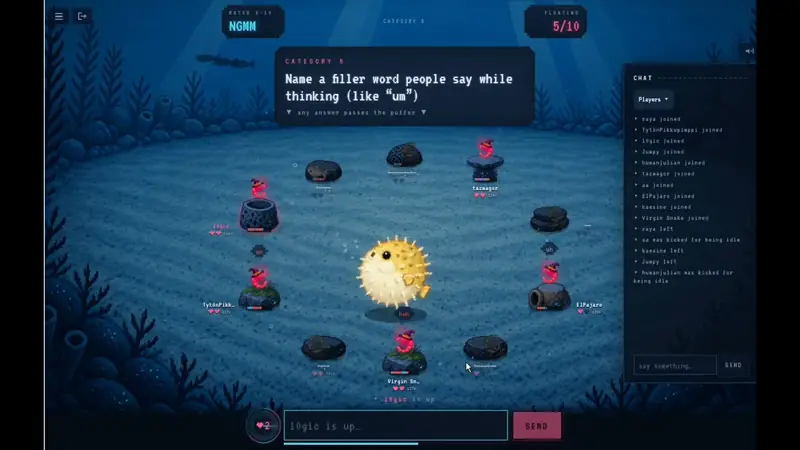
Read the category and submit an answer while you hold the puffer. An accepted answer passes it on; prepare a different candidate while another player has it. You risk losing a life if it pops on you, and the last remaining player wins. The Nisu room guide separately describes the answer-and-pass loop, but did not complete a match. Treat the minimum-turn field as a setting, not a verified guarantee for each holder.
The settings file also lists a 3000 ms countdown, 1500 ms pop freeze, a minimum of 2 players, a 10-life ceiling and a 16-player ceiling. These are single-source client constants checked on 28 October 2026, not independently tested server limits or selectable matchmaking sizes.
Valid answers
Krillion’s FAQ, on the same date, says answer sets are aggregated from dictionaries, wiki pages, and encyclopedias, then merged and cleaned. Some prompts are scored against a familiarity database. Others use a language model plus a manual pass. The FAQ also says a fair answer can be missing because a source was missed, and autocorrect checks aliases, which is why a near miss can become a different name.
Rarer answers and hearts
The public scoring file lists the rarity points below. Each tier value is single-source: the official page and its files are one publisher. The default meter target is 600, also recorded in Nisu’s private-room notes. The dialog describes earning an extra heart; the sources checked do not establish a rule for bringing an eliminated player back.
| Label | Meter points (single-source) | Where |
|---|---|---|
| Plankton | 10 | Client tier table, 2026-10-28 |
| Too Clever | 15 | Same table |
| Schooler | 30 | Same table |
| Rare | 60 | Same table |
| Deep Cut | 85 | Same table |
| One in a Krillion | 100 | Same table |
No repeats
The third dialog line is the whole rule the page publishes: you cannot reuse an answer for the current question. It does not say whether a later question can repeat a word. I am not filling that gap.
Modes
The public client lists 1V1, 3S, 4–6 and 8–10, with 4–6 as its Quick Play default. Nisu’s 27 October lobby notes separately confirm a 1V1 selector and larger group options. The exact 3S, 4–6 and 8–10 labels and default selection remain single-source in this check. The room default of 6 seats is separately recorded by Nisu; a client ceiling does not establish a mode you can choose or a tested capacity.
Timer and minimum turn
The client fields are minTurnMs: 8000, fuseMinMs: 10000 and fuseMaxMs: 30000. The 8-second minimum has a second publisher in Nisu’s room-panel notes; the 10–30-second fuse range remains single-source. Neither reading independently verifies server timing or proves hosts can edit every timer field.
The Different times in Puffer Party discussion contains reports of shorter-feeling turns. Replies suggest connection, synchronization or processing delays, and changes as a question continues. These are player explanations with no confirmed cause, not measurements that replace the client settings. The separate short-timer thread in the source list could not be re-read in this check.
What not to copy from clone sites
A fixed per-turn countdown, a different starting-heart count or a different scoring scale needs its own evidence. Use the current room settings and the dated source limits above before applying a generic description from another site.
Read tips for pacing, answers for practice and cheat-tool questions, and rating for the distinction between ratings and avatar unlocks.
FAQ
How many hearts do you start with?
Krillion’s client defaults and Nisu’s private-room observation both show 2 starting lives and a heart cap of 5. Check your room settings; these are not universal match limits.
How long is a turn?
The client lists an 8-second minimum turn, also observed in Nisu’s room notes. Its 10–30-second fuse range is single-source from Krillion. Neither value guarantees the time each player will experience; lag explanations in community replies remain unconfirmed.
What wins the round?
The public page says the last person still floating wins.
Sources and verification
Public references checked 2026-10-28. Different pages from the same publisher count as one source. A source’s report is not a guarantee of current game behavior.
- Krillion — Puffer Party — Official description, lobby and game mode labels.
- Krillion FAQ — Official app plans, answer curation, developer and ad-removal statements; one publisher.
- Krillion public room settings file — Room defaults, code alphabet and limits; official client, not a second independent source.
- Krillion public scoring and character file — Rarity points and avatar streak thresholds; single official source unless independently corroborated below.
- Nisu — private rooms — Independent dated room notes; corroborates lives 2, minimum turn 8s, seats 6, heart cap 5 and 600 points per heart.
- r/Krillion — Different times in Puffer Party — Player timing reports; explanations of lag are suggestions, not established causes.
- r/Krillion — Time to answer is so low — Separate report of differing perceived turn times; does not override client defaults.
- Krillion.io (2026) Gameplay - Puffer Party — cited gameplay or skin video; the date is supplied by YouTube.